Quick read
- Singles’ Day gave Alibaba more than a sales event: a fixed deadline and public result brought scattered capabilities together into a company-wide growth engine.
- This is the White Hole Theory: broad experimentation matters when a narrow outlet turns it into one business that strengthens the rest of the company.
- AI is Alibaba’s next major bet, but investment and cloud growth alone do not establish another Singles’ Day. The test is whether Qwen, commerce and enterprise tools can converge around a repeatable, paying use case.
In 2009, the Chinese internet had a front door, and it didn’t belong to Alibaba. Most of China’s 384 million internet users started their day at a portal like Sina or NetEase, in Tencent’s QQ, or in a search box; seven in ten used a search engine, which mostly meant Baidu. E-commerce sat downstream: a destination that traffic was distributed to, not a place that generated it.
So when Daniel Zhang, the new head of Taobao Mall, Alibaba’s marketplace for brands, needed shoppers to remember its name, he ran a sale. He picked November 11, a dead spot between the October holiday and Christmas that students jokingly called Singles’ Day. Twenty-seven brands took part, and the day did RMB 52 million.
Six years later, Zhang was Alibaba’s CEO. In between, that sale turned Alibaba from a company that rented attention into one that manufactured it, and lifted the whole company onto a new level. I call the pattern White Hole Theory. This article lays it out, tests it against Alibaba’s numbers, and asks whether AI can do it again.
The Anxiety of the Shopping Flow
A marketplace downstream of portals and search engines does not make demand; it hosts it, and pays a toll to whoever owns the front door. Alibaba knew it: in 2008 Taobao blocked Baidu’s crawler rather than let a search engine stand between it and its shoppers. But closing someone else’s door is not the same as building your own.
Underneath was the anxiety every marketplace lives with: the anxiety of the shopping flow, the stream of wants a consumer moves through every day. Someone who wants a winter coat thinks about the coat, not the store, and whichever door is closest gets the sale. A marketplace that isn’t the first place a consumer thinks of has to rent its way back into her attention, again and again.
So every Alibaba business hunted for traffic on its own, and kept hunting for years, through stakes in Weibo, UCWeb and Youku Tudou. Jack Ma called the result a zoo, not a farm, and the logos made it literal: a cat for Tmall, a bird for Cainiao, an ant for Ant Financial. Many animals, no main line.
Singles’ Day changed that. Alibaba already sold search ads, but the attention it sold had been sent by someone else; at heart it was closer to an e-commerce SaaS company, selling storefronts, payments and tools to merchants, than to a media company. Singles’ Day was content: a date everyone knew, a countdown, a live scoreboard, later a televised gala. People came on November 11 because the event existed. A sale reminds consumers that a store exists; a day in the calendar makes them come looking. Alibaba had stopped renting attention and started owning a fixed place in the shopping flow.
White Hole Theory
In physics a black hole only takes in, a white hole only gives out, and a wormhole is the passage between them. I think a great company’s breakout follows the same sequence, which Figure 1 lays out.
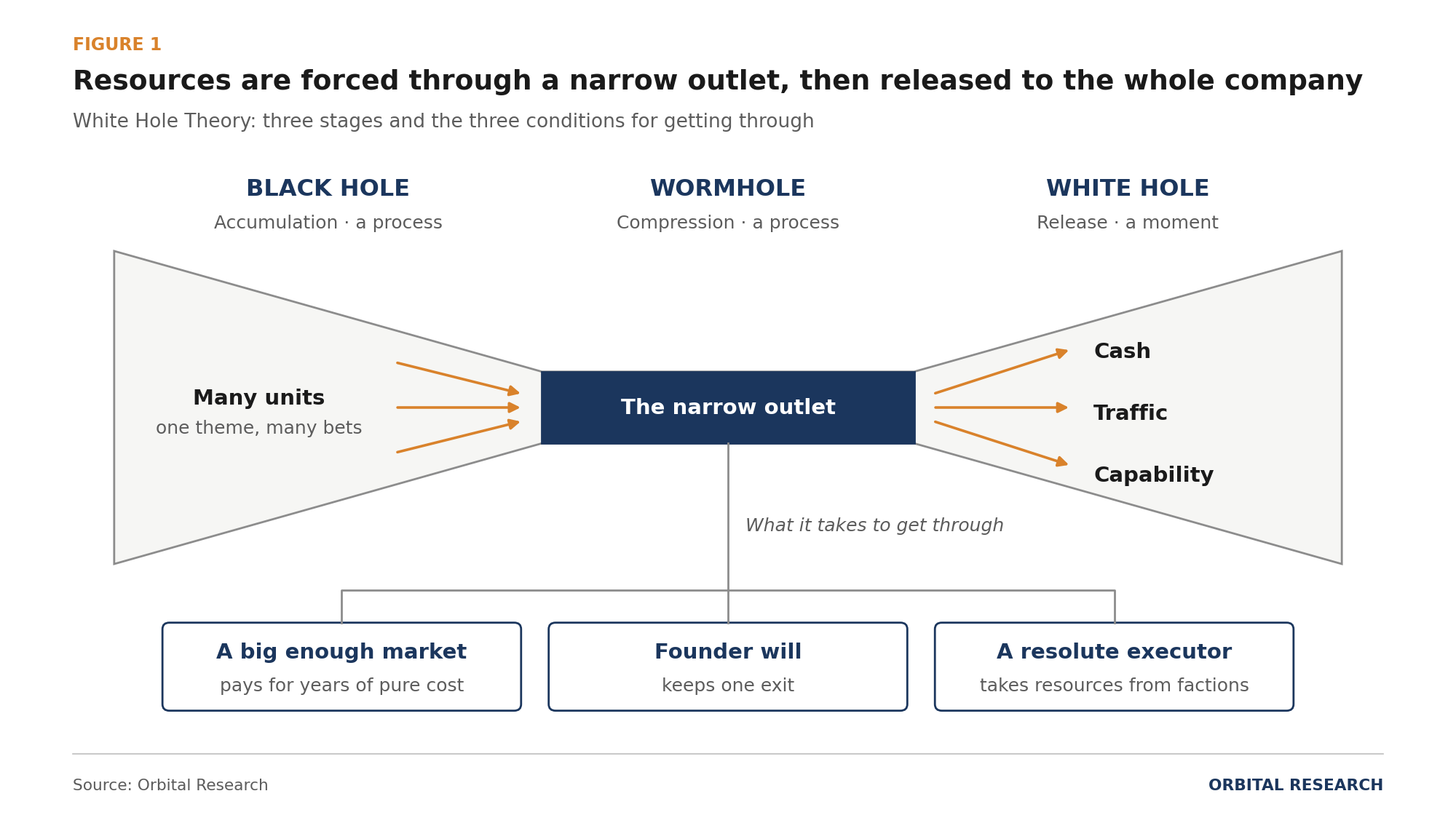
The black hole: accumulation. A company commits to a big theme without knowing where the answer lies, so several units explore it at once. From the outside it looks like waste; from the inside, like chaos, because nothing can be measured yet. But it produces fragments: technology, people, and knowledge of dead ends. If the bets share a theme, the fragments can later be combined; if not, it was just burning money. What a black hole cannot do is end itself.
The wormhole: compression. Fragments become a whole by being forced through a narrow outlet: one business or occasion with a fixed deadline, a public result, and a demand no single team can meet. The outlet selects, because results replace claims; integrates, because no team can pass through alone; and reallocates people and authority to the winning channel and to the person running it. It has to be narrow: with several exits, every faction keeps its own and nothing integrates. That is why the wormhole is turbulent, and where most companies break. Getting through takes three things:
- A big enough market to pay for years of pure cost
- Founder will to admit every other direction was wrong and keep one exit
- A resolute executor to take resources from factions, with the founder absorbing the backlash
The white hole: release. This is a moment, not a stage: the outlet business becomes the engine of the whole company. Capabilities built for the outlet far exceed what daily operations need, so they spill over as cash, traffic and capability that feed businesses at every stage. Feeding is the test; a hit product succeeds alone. And a white hole expires, because the outlet was built for one environment.
The Outlet: One Flood a Year
At Alibaba, the outlet was Singles’ Day. Its GMV went from RMB 52 million in 2009 to RMB 91.2 billion in 2015, and every year the system that barely held the last flood could not hold the next. Trading, payments, databases, compute and logistics all had to scale against the same midnight deadline, and connect to each other, as Table 1 shows:
Table 1: What each Singles’ Day forced into existence
| Year | GMV (RMB bn) | Peak orders per second | What plugged in |
|---|---|---|---|
| 2012 | 19.1 | Alibaba Cloud’s first Singles’ Day | |
| 2013 | 36.2 | Cainiao, the logistics network, founded | |
| 2014 | 57.1 | 80,000 | In-house database carries payment traffic |
| 2015 | 91.2 | 140,000 | Runs on a hybrid cloud |
| 2017 | 168.2 | 325,000 | Mobile reaches 90% of GMV |
| 2019 | 268.4 | 544,000 | Core systems fully on Alibaba Cloud |
Nobody drew up an integration plan. The lines connected because at midnight every November 11 they had to hold together.
The market paid for it. China’s smartphone shipments went from about 91 million in 2011 to 213 million in 2012 and roughly 420 million by 2014; hundreds of millions of people were buying their first internet device. In October 2013 Zhang made mobile the group’s top strategy, and Singles’ Day forced the shift: mobile went from 43% of the event’s GMV in 2014 to 68% in 2015. By 2015, shipment growth had stalled at 2.5%. A big enough market is a window of time, and Alibaba’s window was the years when China bought its first smartphones.
May 2015: Where the Great Journey Began
A white hole is hard to date, so you look for a marker. At Alibaba it is May 10, 2015, when Zhang became CEO. The appointment didn’t create the white hole; Singles’ Day had been lifting the company for six years. It recognized that the outlet was now the core, so the person who ran it should run everything. Seven months later he reorganized Alibaba around a “big middle platform, small front end”: the outlet’s capabilities, turned into an org chart for the whole company.
Figure 2 compares Alibaba’s growth with a decelerating market. Alibaba’s fiscal years and national calendar-year retail statistics are not perfectly aligned, so the gap is indicative rather than a clean causal estimate:
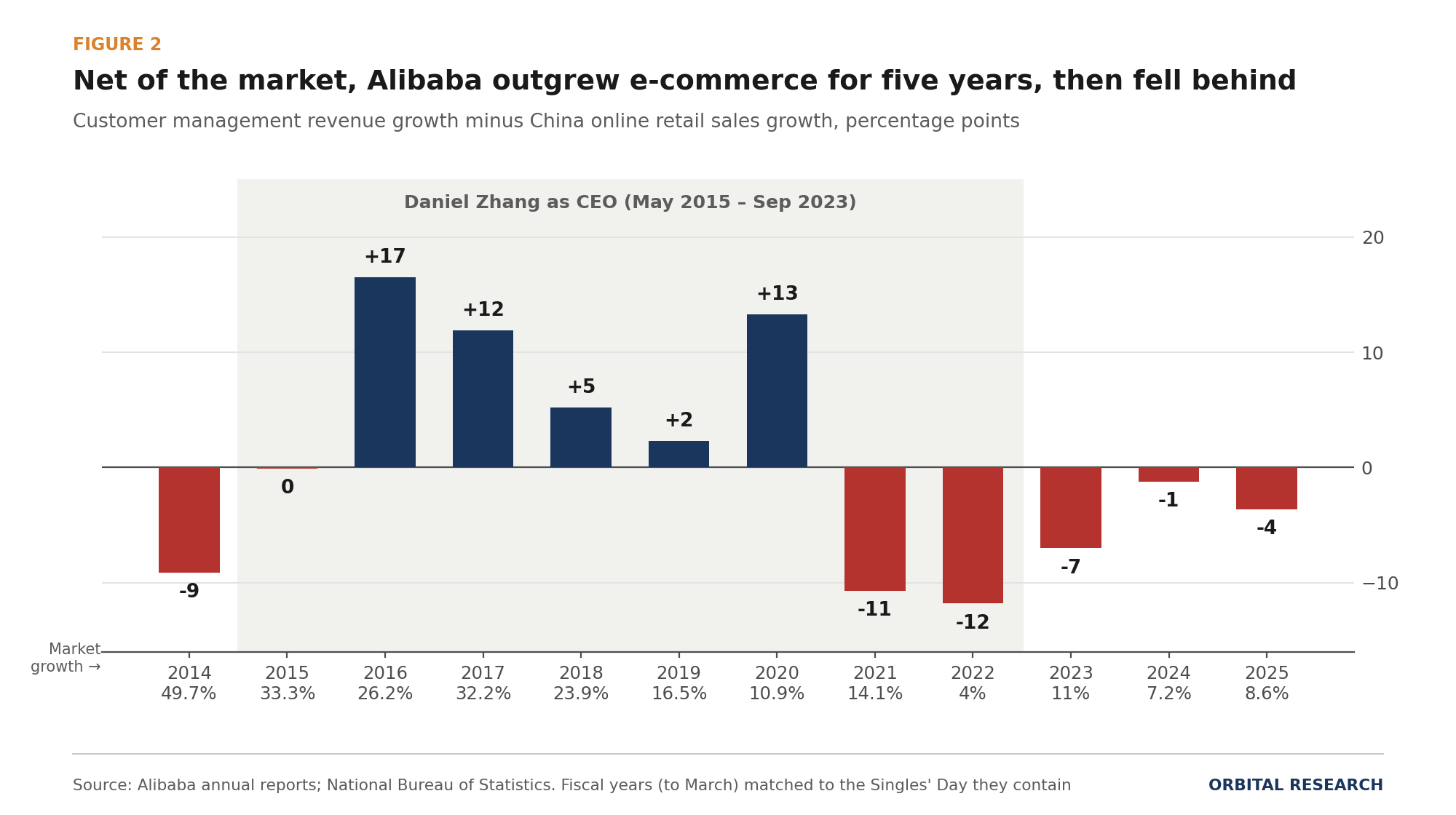
Before the marker, Alibaba’s customer management revenue, the ads and commissions merchants pay, grew 9 points slower than China’s online retail sales. Then it matched the market, then beat it by 17 and 12 points in years when the market grew 26% and 32%. That revenue line is the media company Singles’ Day created; when it outgrows the market, Alibaba’s attention is worth more than everyone else’s.
The take rate tells the same story, in Figure 3:
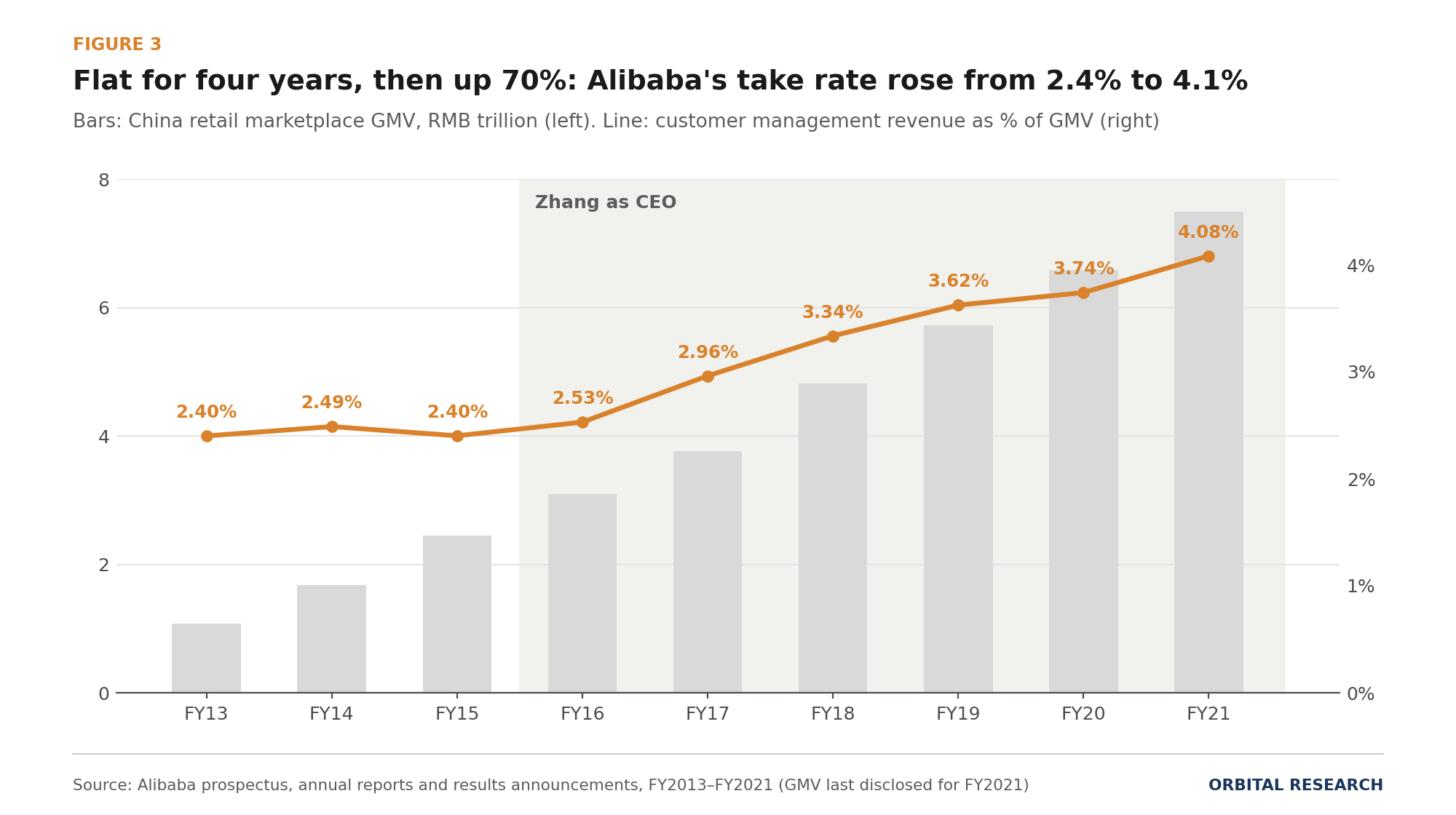
A SaaS business grows with merchant volume; a media business can charge more per yuan as its attention gets scarcer. Alibaba’s cut of each yuan sold was flat at about 2.4% through FY2016, then rose five straight years to 4.1%, and Alibaba’s own filings credited online marketing services. Tmall mix, mobile monetization and other changes also contributed. The ratio supports the interpretation that Alibaba monetized commerce more effectively; it does not isolate Singles’ Day’s causal contribution.
The feeding was real. Compute built for one day a year became a cloud business with RMB 158 billion in revenue by fiscal 2026; Cainiao became a logistics company in its own right. (The payments capability mostly accrued to Ant, which Alibaba spun out in 2011.) By 2018 Zhang was calling the whole thing the Alibaba Economy. The zoo had a main line.
White Holes Expire: Shopping Flow Divergence
The monthly-close comparison used in Figure 4 puts Alibaba’s share-price rise at about 112%, against JD’s 28%, over the selected two-year window after the marker. These are price changes, not total shareholder returns; exact start and end closes remain to be independently checked. Then it peaked, as Figure 4 shows.
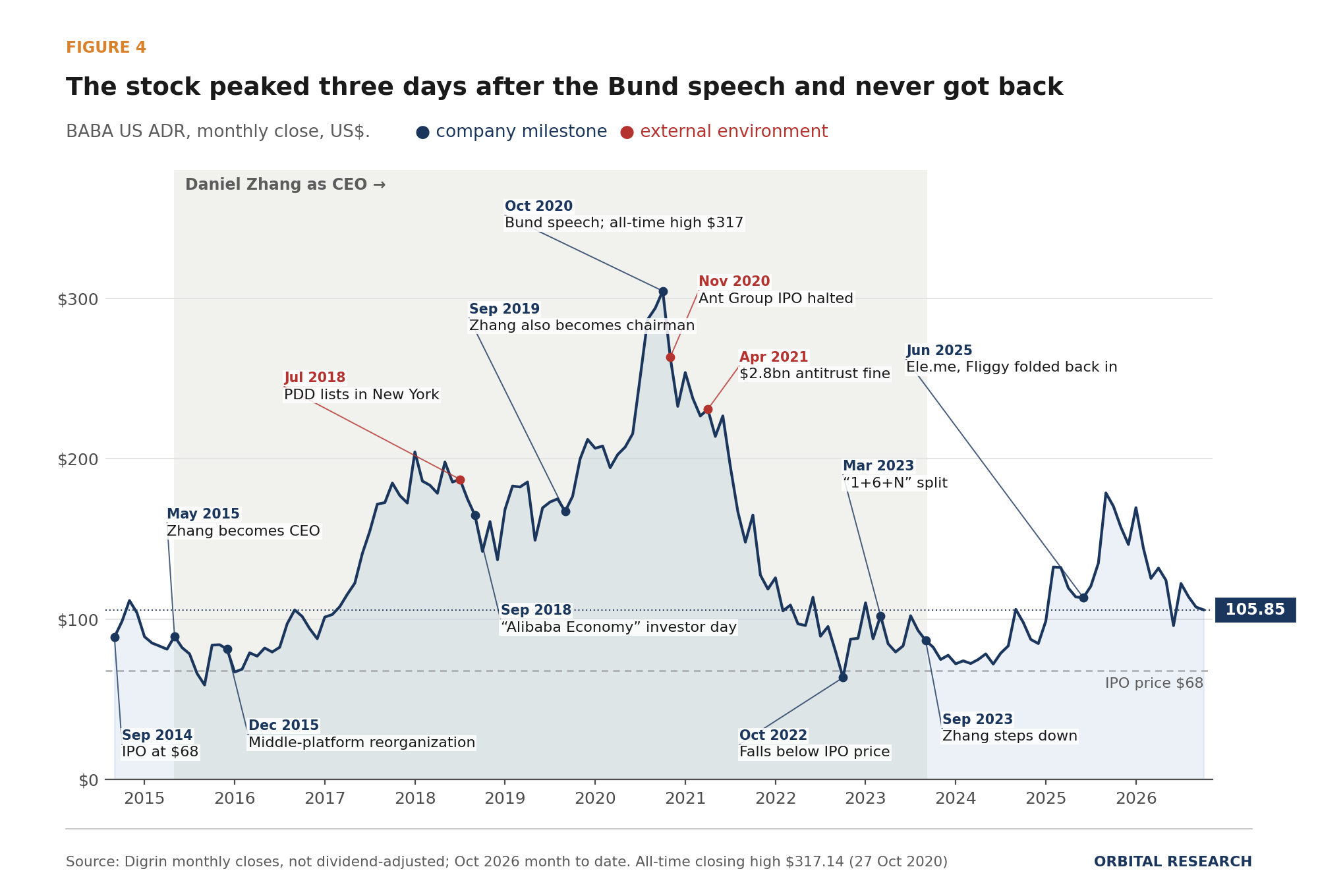
The sharpest turn was external. On October 24, 2020, Jack Ma told the Bund Summit that China’s financial system had a pawnshop mentality; three days later Alibaba closed at its all-time high, and on November 3 regulators halted Ant Group’s IPO. A big enough market is also the room the state allows a company to occupy, and that room shrank overnight.
But regulation is not the whole story. The excess growth in Figure 2 started shrinking in 2018, two years earlier, because the shopping flow itself diverged. The new users were in smaller cities, where PDD went after the price-sensitive shoppers Alibaba and JD were ignoring; by the end of 2020 PDD had 788 million buyers to Alibaba’s 779 million. Discovery moved from search boxes to WeChat groups, then to Douyin’s short videos and livestreams. Alibaba even ran the new playbook inside the old outlet, pushing livestreams into smaller cities on Singles’ Day 2019, and still beat the market by just 2 points that year. A once-a-year shelf event cannot compress traffic that no longer passes through the shelf.
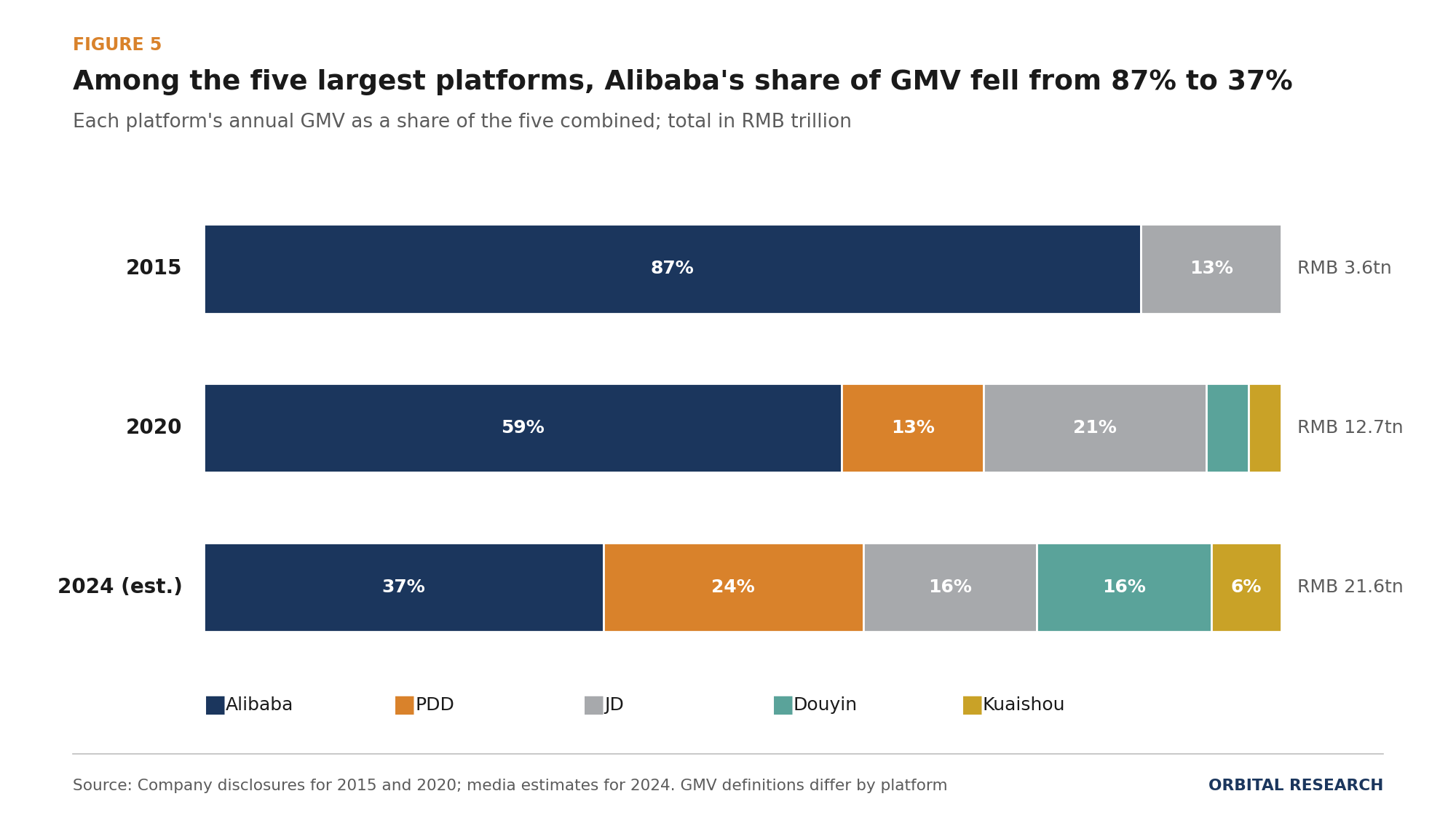
In the compilation used for Figure 5, Alibaba’s share of the five platforms’ combined GMV fell from about 87% in 2015 to 37% in 2024; it captured less than a third of their combined growth over that period. These are estimates with differing reporting periods and GMV definitions, not a measure of the entire Chinese retail market. Its estimated GMV rose between the two endpoints. What it lost was the growth.
The next question is how much of that growth a platform can keep as profit. My comparison of PDD, JD, Alibaba and Amazon examines why efficient matching and low prices do not necessarily produce a lasting profit advantage.
The organization followed. By 2021 the middle platform had become friction, and in March 2023 the “1+6+N” split broke the Alibaba Economy back into separate animals; six months later Zhang left. The executor’s tenure and the white hole’s lifespan overlapped, as the theory predicts: the person best at forcing everything through the old outlet is not necessarily the one who finds the next theme. And the market Alibaba squeezed out became somebody else’s theme. One company’s white hole marks out the next company’s black hole.
Can AI Do It Again?
Alibaba’s new theme is AI, on a scale it has never bet before: a RMB 380 billion commitment in February 2025, half of it spent by June 2026, and then, in August 2026, a HK$80 billion share placement, Alibaba’s first new shares since its 2019 Hong Kong listing, with every dollar earmarked for AI. The reason it needs outside money is in the same quarter’s results: capital spending up 75%, operating profit down 57%, free cash flow negative. That is what a wormhole costs, years of pure cost that something has to pay for. In 2014 the market paid for the last outlet through the largest IPO in history; in 2026 it is being asked to pay for the next one. And what Alibaba is spending is what the last white hole produced. The evidence that cloud is the second curve is in the business-to-business numbers, in Figure 6:
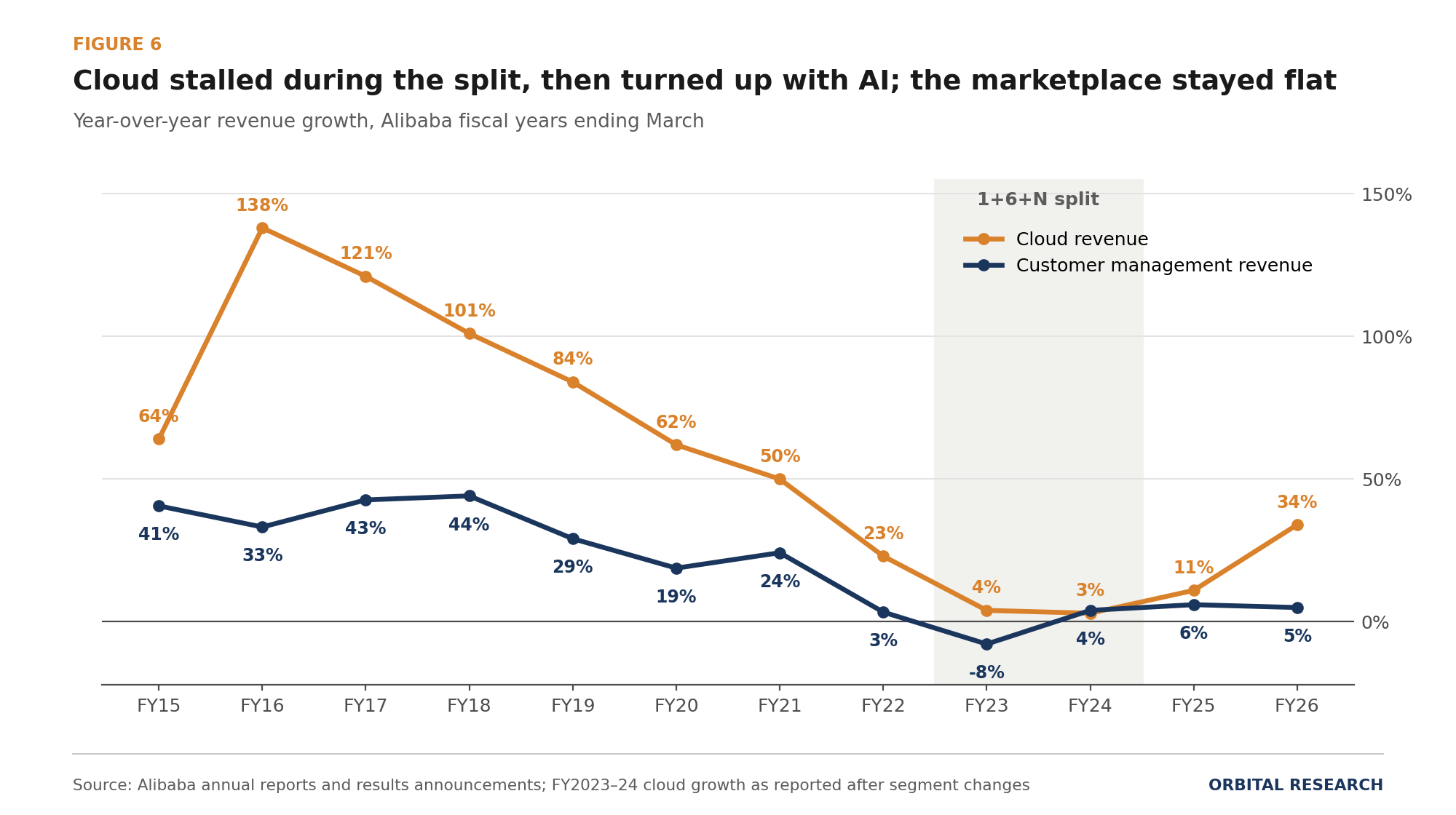
Cloud grew fast for a decade as a by-product of the outlet, stalled at 3% to 4% during the 2023 to 2024 split, then turned: 11%, 34%, and 45% in the June 2026 quarter, with adjusted EBITA up 133%. Reported customer management revenue fell 7%; excluding the contra-revenue impact of a new business development program, it would have grown 1%. Cloud is accelerating, although it is not Alibaba’s only growing business: China Quick Commerce revenue also rose 45% that quarter.
But growth is not feeding. AI Labs and Applications, the segment that houses the Qwen models and apps, reported an adjusted EBITA loss of RMB 13.9 billion that quarter. Alibaba attributed the widening loss to investment in AI capabilities and higher inference costs for the Qwen app, without quantifying each contribution. My reading of its willingness to absorb those costs is the front door. If shoppers start by asking an AI assistant what to buy, Taobao is downstream once more. So Alibaba is wiring the assistant into the store. Alibaba’s June-quarter results describe a Qwen Shopping Assistant launched in May on the Taobao app, covering inspiration through after-sales service, as well as deeper integration between Qwen app and its commerce services. This is the first candidate in a decade that looks like the old outlet, because it forces traffic, ads, payments and fulfillment to work together in one place.
The consumer numbers are not there yet. A RMB 3 billion Spring Festival campaign took the Qwen app from 7 million to 74 million daily users in two days; by June its monthly users had flattened at 167 million, against Doubao’s 382 million. A promotion buys users once. An outlet forces something into existence every year.
The same distinction between attracting users and building a paying business runs through my analysis of ByteDance’s AI strategy and Doubao monetization: the question is whether a new assistant can earn enough to support the business being built around it.
Table 2: The five questions, applied to Alibaba’s AI bet
| Question | Alibaba in 2026 |
|---|---|
| One theme? | Yes: cloud, Qwen, and AI across Taobao, Alipay and the apps |
| A narrow outlet? | Forming: shopping through the Qwen agent, wired to Taobao and Alipay, is the strongest candidate, but its users have stalled |
| Market, founder, executor? | Yes: a huge market, HK$80 billion of new equity, and co-founder Eddie Wu running both the group and the cloud |
| Feeding? | The reverse: the old white hole is feeding the new bet |
| Environment? | Wide open for business customers; the consumer front door is contested |
Most companies stop at the third question. Alibaba has answered it with the largest follow-on offering in Hong Kong’s history, and is stuck at the second. It has a candidate outlet, an agent that has to make search, ads, payment and delivery work together, but not yet the forcing function: the one fixed date, the one public number that makes every team pass through at once. One company can illustrate a framework but not prove it, and I chose Alibaba’s marker with its numbers in view. But the shape is clear enough to say what is missing.
Charlie Munger’s Daily Journal bought Alibaba in early 2021, just after the peak. Two years later he told shareholders:
I regard Alibaba as one of the worst mistakes I ever made.
I didn’t stop to realize they’re still a goddamn retailer.
That is what an expired white hole looks like from the outside: the market stops seeing the media company and sees the store. But it undersells Singles’ Day. It was the greatest branding event in business history, a made-up date that, like Christmas, became a season of its own. The bigger story is what it did to the company that invented it: it turned a zoo downstream of other people’s traffic into a media company with a fixed place in the shopping flow, an economy it fed, and a cloud born from one night of load. Alibaba doesn’t need to prove that it is a good retailer. It needs to prove that AI can be its next narrow outlet.
Alibaba is not making this bet alone, and that may be the most important fact of all. In 2026 China’s three richest internet companies all went outside for money to fund AI, each in its own way, as Figure 7 shows:
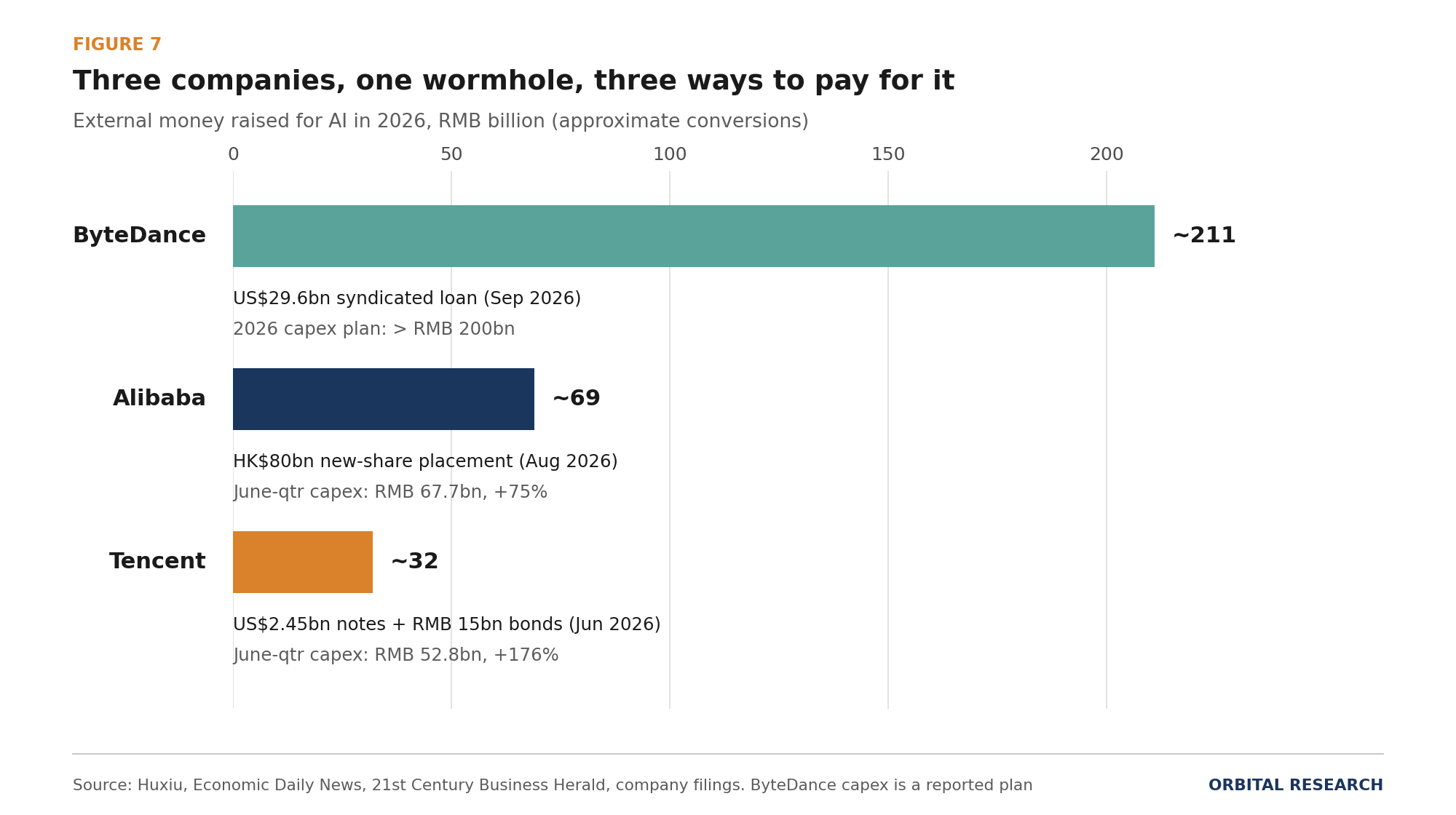
According to Huxiu, ByteDance arranged US$29.6 billion in borrowing from nearly thirty banks; the amount drawn and its allocation to AI have not been independently verified here. Its reported capex plan was raised to more than RMB 200 billion for the year. Tencent, whose June-quarter capex jumped 176%, sold bonds, some of them thirty-year paper. Alibaba sold equity. Three companies are paying for the same wormhole, and they are paying with different kinds of conviction: a loan says the cash flows will come, a thirty-year bond says they will last, and new shares say the company would rather dilute its owners than slow down. Each also arrives with a different asset: ByteDance owns the most used AI assistant in China, Tencent owns WeChat, and Alibaba owns the store. A white hole needs one narrow outlet. Which of the three finds it first is a question for another article.
Sources
- The 2009 internet: CNNIC via Digitimes and Impress
- Singles’ Day GMV and capacity (Table 1): Business Weekly, Woshipm, INSIDE 2018, INSIDE 2019, Baidu Baike, TechNews, Alibaba Cloud, 36Kr. Figures for 2014 to 2016 are compilations rather than Alibaba’s own announcements
- People and organization: ifanr, PEdaily, PEdaily (zoo remark), cnyes (middle platform), Alibaba News (Alibaba Economy), INSIDE (1+6+N)
- Smartphone market: IDC via the Internet Society of China; 2011 derived from 2012 growth, 2014 is IDC’s estimate at the time
- Figure 2: customer management revenue from Alibaba’s prospectus and annual reports (like-for-like where restated); national online retail sales from the National Bureau of Statistics and Ministry of Commerce (2014, 2017–19, 2020–22, 2024); the 2025 figure has not been checked against the original release
- Figure 3: customer management revenue from Alibaba’s prospectus and annual reports (FY2015, FY2016), divided by China retail marketplace GMV (FY2019, FY2020, FY2021)
- Figure 4: monthly closes from Digrin; all-time high from ChartRow; Ant IPO halt from GVM and The Storm Media
- Figure 5: Alibaba FY2016 and FY2021; JD 2015 (2020 from its annual report); PDD 2020; Douyin and Kuaishou 2020; 2024 estimates from one compilation
- Figure 6 and AI section: Alibaba’s fiscal 2026 annual report, March 2026 and June 2026 quarter results; China Daily; Implicator; 10jqka; RCCaijing; QuestMobile via ifeng. Qwen shopping integration is described in the June-quarter filing. Earlier industry claims of four billion listings and 300 million agent-payment transactions were not independently verified and are excluded from the argument
- Figure 7: Huxiu, Economic Daily News via UDN, Tencent results via UDN, 21st Century Business Herald; RMB amounts are approximate conversions
- Charlie Munger: Business Insider, Benzinga
- From the author’s knowledge, not linked: Taobao’s 2008 block of Baidu’s crawler; Alibaba’s stakes in Weibo, UCWeb and Youku Tudou; the first televised Singles’ Day gala (2015)
Get the next note
in your inbox.
Free research notes, selected readings and publication updates. No spam, unsubscribe any time.