Quick read
- Recommendation turned Douyin into ByteDance’s growth engine by connecting attention, advertising and commerce. Generative AI has not yet produced the same reinforcing business.
- Doubao’s large audience shows demand, but inference costs rise with use. More users become a durable advantage only when revenue can support the cost of serving them.
- Feishu and enterprise workflows could connect ByteDance’s models to paying work. The next breakthrough needs a concrete use case that brings its scattered AI bets together—not user scale alone.
In 2012, the front door of China's internet was a search box. About seven in ten Chinese internet users searched to find what they wanted, and most of them typed the query into Baidu. To be found, a business had to be searched for. To be read, an article had to be clicked on from a results page.
That year Zhang Yiming launched an app that asked its users for nothing. Jinri Toutiao had no search bar to fill in and no friends to follow. It watched what you read and chose what came next. Nobody at the company knew how to build a recommendation engine. Zhang's answer was short:
We don't know recommendation, but we can learn it.
By early 2018 Toutiao had 120 million daily users. By 2019 the company behind it, ByteDance, had passed Baidu to become the second-largest digital advertiser in China.
Fourteen years on, the same company owns China's largest short-video app and its most-used AI assistant. Douyin passed one billion monthly users in March 2026; Doubao had 345 million monthly users in March 2026. These look like two businesses. This article argues they are one story told twice: recommendation beat search, and generation is now trying to beat recommendation. It applies the White Hole Theory developed in our analysis of Alibaba’s Singles’ Day transformation to ask whether the same company can pass through the same narrow door a second time.
From Search to Recommendation
Search waits for you to ask. Recommendation does not. That difference mattered more in China than anywhere else, because hundreds of millions of Chinese people came online without ever learning to ask a machine anything.
Americans got computers first and phones second. In 2015, 78% of US households had a desktop or laptop. China skipped that step. By the end of 2016, 95.1% of Chinese internet users went online by phone, and 80.7% of that year's new users arrived on a phone rather than a PC. At the end of 2016, 46.8% of the population was still offline. A separate survey of non-users at the end of 2017 asked why they stayed offline. 53.5% said they did not understand computers; 38.2% said they could not type pinyin. A search box needs pinyin. A video does not.
The phones that carried them came from OPPO and vivo, sold through shops in small towns. In 2016 OPPO shipped 78.4 million phones in China, up 122%, and vivo 69.2 million. IDC credited their retail networks in lower-tier cities.
The Idler Economy
Kuaishou caught these users first. Chinese slang calls them jieliuzi, idlers: young people in small towns with a new phone, a lot of time, and nowhere they had to be. Kuaishou turned from a GIF tool into a video community in 2013 and reached ten million daily users by January 2015, without a feed of celebrities or a search bar.
Idlers have time, and recommendation sells time. What they lack is money, and advertisers price that in. In 2020 Kuaishou users spent 87 minutes a day in the app, yet each brought in only RMB 82.6 of advertising a year. Most of Kuaishou's revenue that year, 56.5%, came from users tipping streamers, not from advertisers. When advertisers will not pay much for an idler's attention, the idlers pay each other.
Table 1: Annual monetization per user or buyer: different revenue measures
| Started with small-town users | Started with big-city users | |
|---|---|---|
| Video, per daily user, 2020 | Kuaishou: RMB 82.6 | Douyin: about RMB 180–275 (estimate) |
| E-commerce, per annual buyer (different fiscal periods) | PDD: about RMB 61 in online marketing and other revenue (2020) | Alibaba: about RMB 377 in customer management revenue, including ads and commissions (FY2021) |
| Spending per buyer per year | PDD: RMB 2,115 | Alibaba: about RMB 9,200 |
Video figures divide annual advertising revenue by daily active users; shopping figures divide annual revenue by annual buyers. PDD uses calendar 2020 and Alibaba uses the fiscal year ended March 2021. The revenue categories and denominators differ, so this is an indicative comparison, not a like-for-like measure of advertising yield. Douyin’s range is a media-based estimate.
The same pattern holds in shopping. PDD had 788 million buyers at the end of 2020, more than Alibaba's 779 million, but each spent a quarter as much. Same attention, a fraction of the price. One difference is worth noting. PDD overtook Alibaba on users; Kuaishou never overtook Douyin. Buying has a price floor, and Alibaba could not chase cheap buyers without hurting its own merchants. Watching has no price floor. The same algorithm could serve a white-collar worker in Shanghai and an idler in a county town. When Douyin launched a lite version in August 2019, 74.7% of its Android downloads came through OPPO and vivo channels.
Winning buyers is only one part of the economics. My analysis of PDD’s competitive advantage and the limits of efficiency examines how low-cost matching can expand a marketplace while competition limits the profit it keeps. That distinction matters here too: a large audience and a durable source of earnings are separate achievements.
The crossover
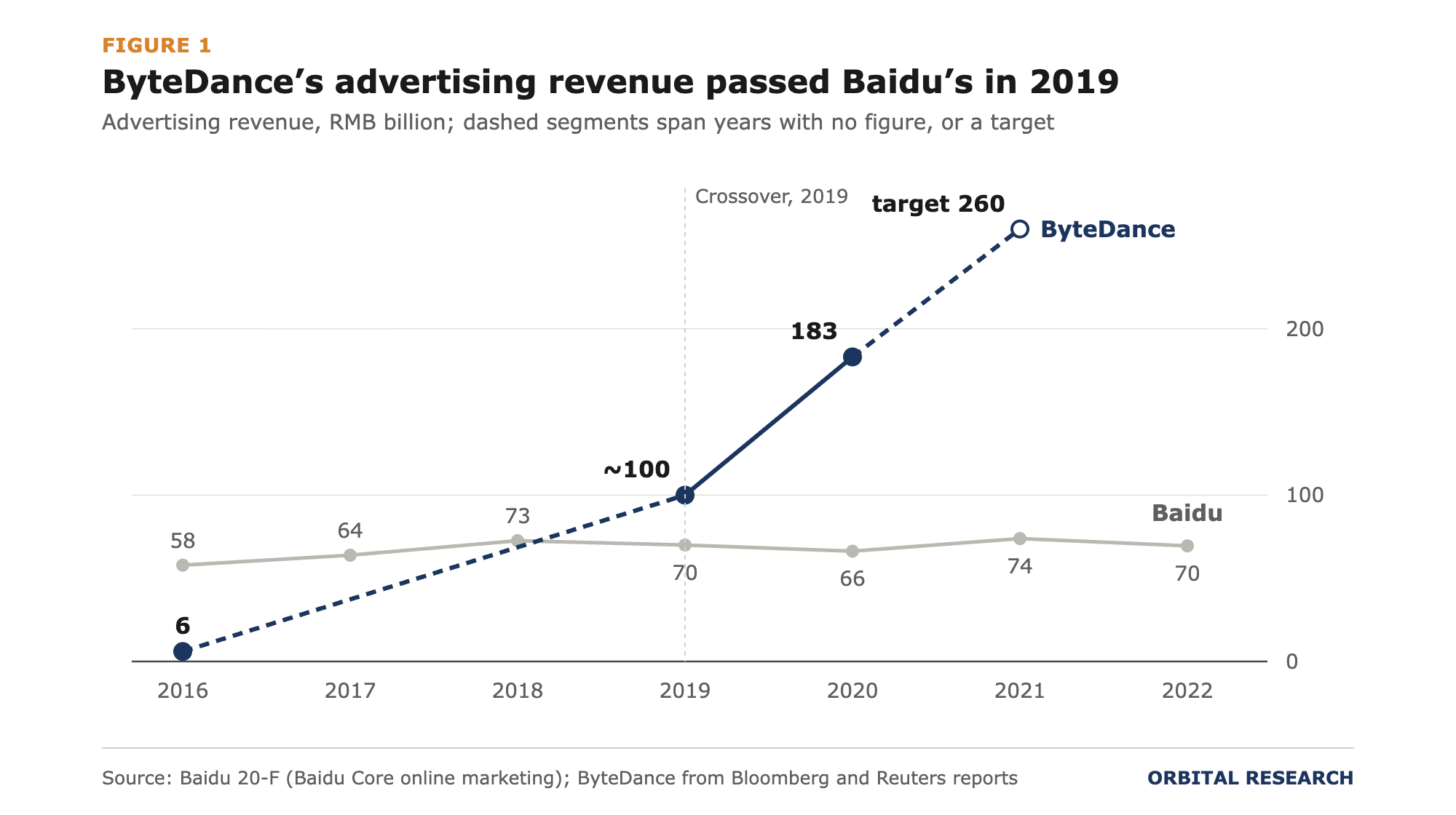
By 2019 the money had moved (Figure 1). Baidu's core online marketing revenue sat between RMB 58 billion and RMB 74 billion every year from 2016 to 2022, essentially flat. ByteDance's ad revenue went from about RMB 6 billion in 2016 to RMB 183 billion in 2020. In the first half of 2019 ByteDance took 23% of China's digital ad spending against Baidu's 17%. Recommendation had beaten search, not in theory but in advertisers' budgets.
White Hole Theory, in One Paragraph
Our Alibaba analysis set out the White Hole Theory model. A company bets on a big theme without knowing where the answer is, so several teams explore at once: the black hole. It looks like waste from outside and chaos from inside, but it leaves fragments behind. Those fragments only become a business when something forces them through a narrow outlet: a fixed deadline, a public result, and a need no single team can meet alone. That is the wormhole. What comes out the other side is the white hole, a single business that reorganizes the company around itself and feeds everything else. White holes expire. This article uses one test throughout: a narrow outlet needs all three conditions, or it is not one yet.
Three Horses, One Outlet
ByteDance's black hole had one theme: take the recommendation engine that worked on news and point it at video. It did not pick one product. It ran three, and two of them copied someone else.
Table 2: ByteDance's three video bets
| App | Modeled on | Daily users, Feb 2018 | What happened |
|---|---|---|---|
| Huoshan | Kuaishou | 26.7 million | Renamed Douyin Huoshan Edition, Jan 2020 |
| Xigua | YouTube | 29.2 million | Folded into Douyin, Nov 2021 |
| Douyin | — | 44.0 million | Broke out |
| Kuaishou (rival) | — | 108.1 million | More than all three combined |
Source: Analysys, via Geekpark.
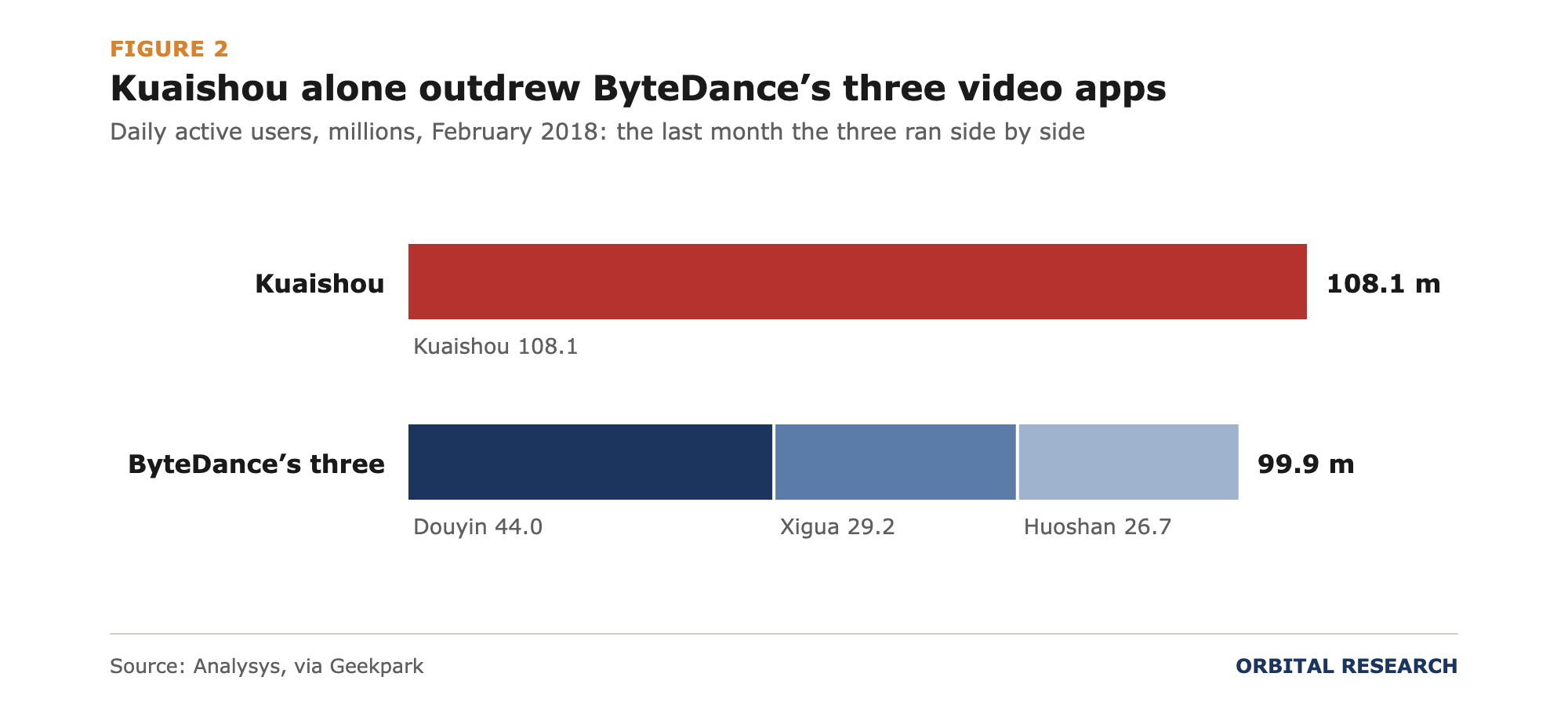
Huoshan was the obvious bet. It launched in 2016 aimed squarely at Kuaishou's users and in May 2017 announced RMB 1 billion in creator subsidies. Xigua went after longer videos. Douyin, aimed at young people in big cities, was the outsider. In early 2018 the company chose Douyin over Huoshan as its main weapon against Kuaishou.
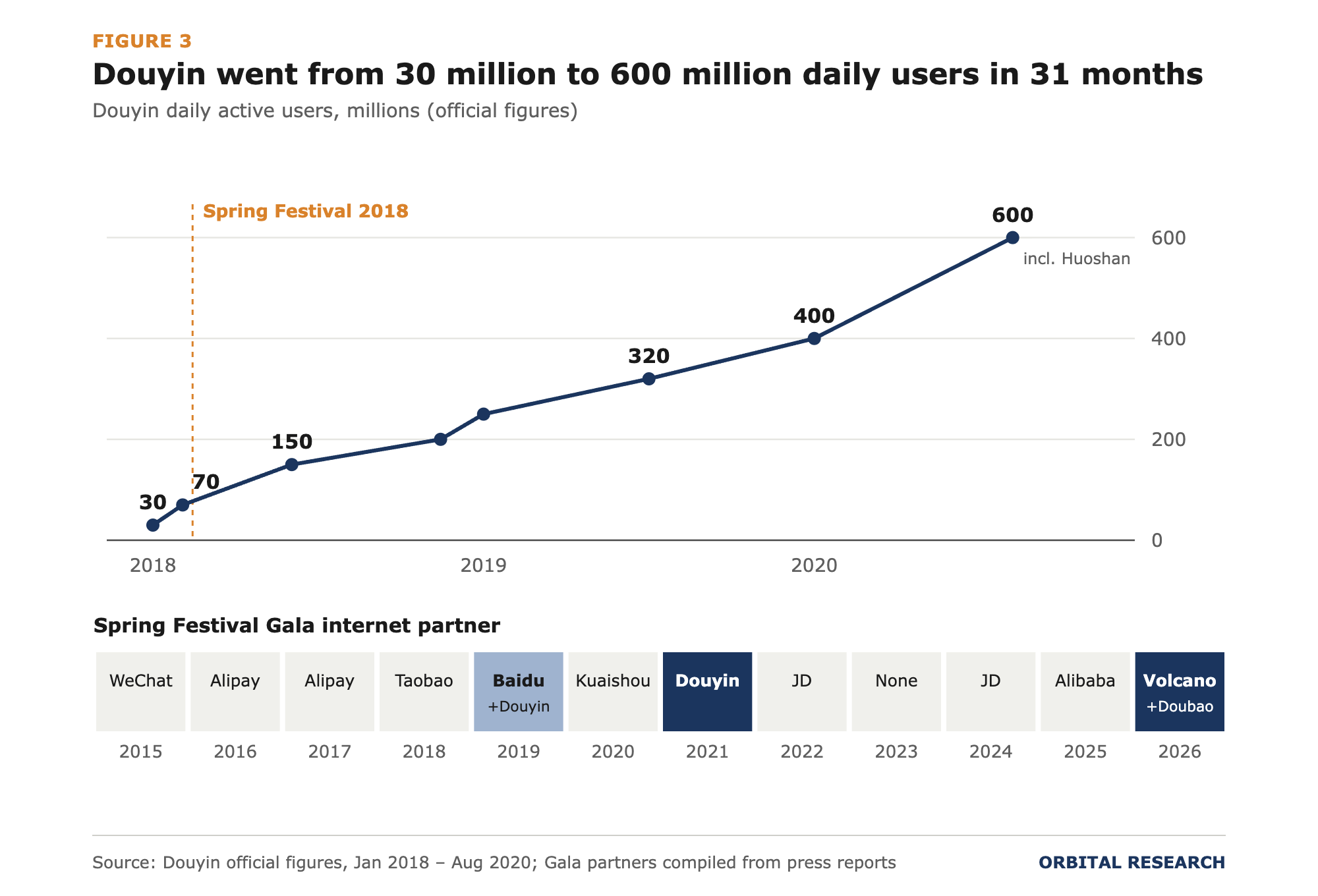
The narrow outlet was Spring Festival 2018. It met all three conditions. The deadline was fixed: a week when hundreds of millions of people sat at home with their phones. The result was public: every app published its numbers. And no single team could meet it alone: it took marketing, content, and infrastructure at once. Douyin flooded the holiday with celebrity red packets. Its daily users went from under 40 million to nearly 70 million over the holiday, reached 150 million by June, and passed Kuaishou in May.
It had help. Meipai, Meitu's short-video app and the former home of many beauty and lifestyle creators, was pulled from app stores by regulators in June 2018. Its monthly users fell from 98 million to 39 million in a year, and its top creators started posting to Douyin first. Meipai fell because of regulators, not because Douyin beat it. But Douyin was where its creators went.
The outside world caught up slowly. The Spring Festival Gala's red-packet partner is a fair measure of who China's internet considers important. In 2018, the year Douyin won its internal race, the partner was Taobao. Douyin got a supporting role in 2019, the red packets in 2021, and in 2026 the company returned with Volcano Engine and Doubao.
The Marker: March 2020
A white hole is official when the person who ran the narrow outlet is put in charge of the core. At Alibaba that was May 2015, when Zhang Yong became CEO. At ByteDance it was March 12, 2020, the company's eighth birthday. Zhang Yiming wrote to all staff that Douyin's CEO, Zhang Nan, would become CEO of ByteDance China, responsible for Toutiao, Douyin, Xigua and search. He would focus on the world outside China.
The parallel is not exact. Zhang Nan took the China business, not the whole company, and shared it with Zhang Lidong as China chairman. But the direction was the same: the outlet became the center. Twenty months later it became the org chart. On November 2, 2021, the new CEO Liang Rubo split ByteDance into six units and folded Toutiao, Xigua, search and Baike into Douyin. Chinese media called it the birth of "big Douyin."
The white hole then fed the rest of the company in three ways.
Feeding one: a new engine for the app factory
ByteDance used to grow new apps on Toutiao's traffic. Douyin replaced it. By 2020 Douyin brought in nearly 60% of ByteDance's ad revenue, Toutiao about 20%, Xigua under 3%. New apps now launch on Douyin's back: Qishui Music had 120 million monthly users in September 2025, 82.1% of them coming from Douyin.
Feeding two: from ads to e-commerce, and the break with Taobao
In 2018 Douyin's shopping cart sent buyers to Taobao. In 2019 Alibaba signed a RMB 7 billion advertising deal with Douyin. In July 2020, 23 of the top 30 products sold on Douyin livestreams still came from Taobao or Tmall. Then Douyin closed the door. From October 9, 2020, third-party products could no longer appear in livestream shopping carts. Short videos could still link out; livestreams could not.
Twelve years earlier, in 2008, Taobao had blocked Baidu's crawler to keep its shoppers inside its own walls. Douyin did the same thing to Taobao. By 2021, Juliang Qianchuan, Douyin's e-commerce ad platform, went from under 10% to 35% of ByteDance's ad revenue, about RMB 60 billion, in seven months.
Feeding three: the overflow
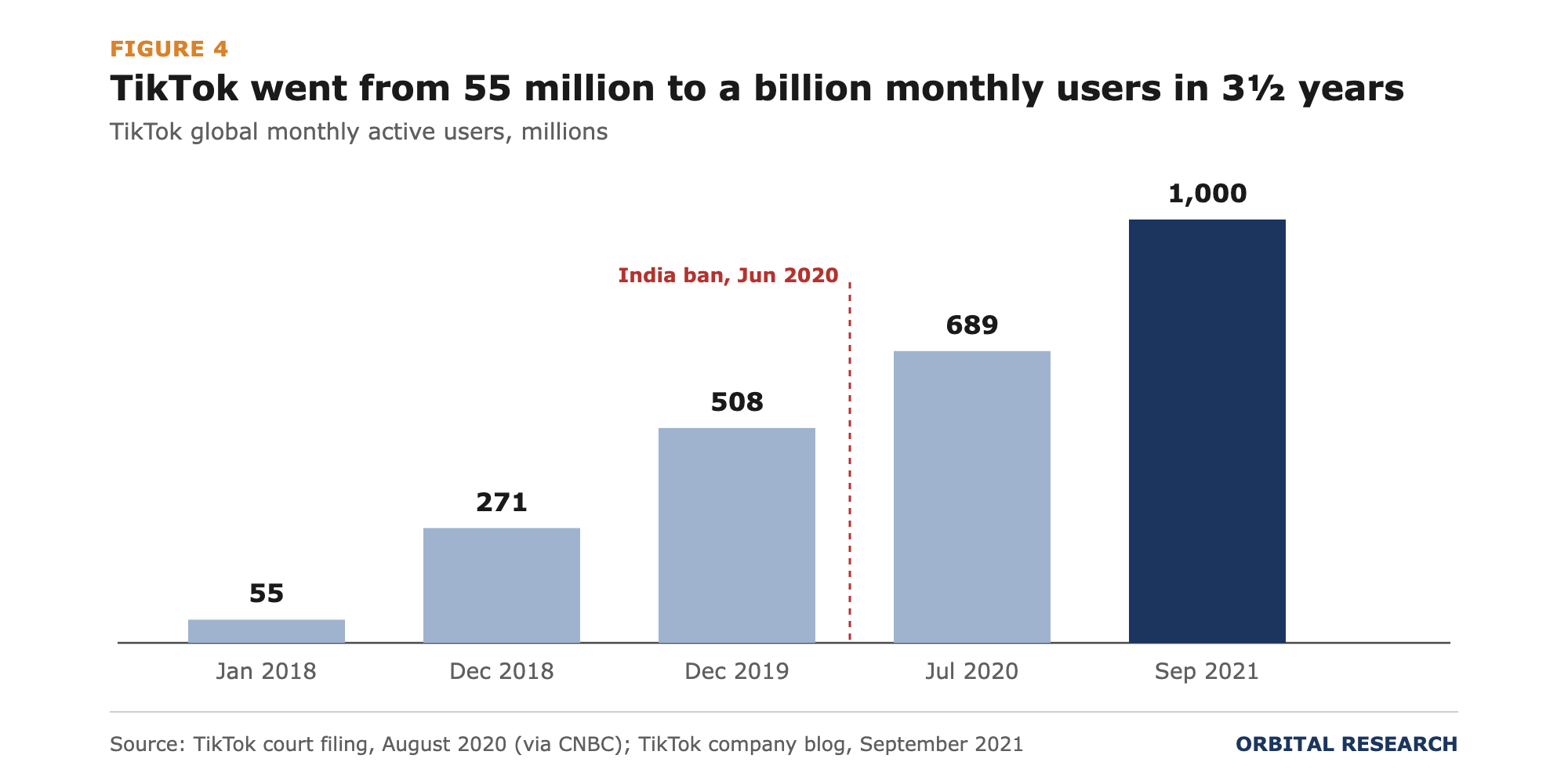
The format went abroad as TikTok. TikTok's monthly users went from 54.8 million in January 2018 to 689 million in July 2020, and it announced one billion in September 2021. That was less than four years after the January 2018 observation. Douyin reached a billion monthly users in March 2026, about nine and a half years after its own September 2016 launch. Douyin and TikTok serve different markets and have different launch histories; these timelines are not a controlled comparison of adoption speed.
Passing Alibaba, Then Tencent
What the white hole produced shows against the two companies that had owned China's internet for a decade. Against Alibaba it came in two steps, first in shopping and then in cloud and AI. Against Tencent it came last, and on the scoreboard investors watch most.
Alibaba, step one: e-commerce
Douyin started as Taobao's best source of buyers and became its fastest-growing rival. The turn came in 2020, when Douyin closed its livestreams to Taobao links. Four years later it was the third-largest shopping platform in China.
- Among the five largest platforms, Douyin's share of GMV rose from about 4% in 2020 to about 16% in 2024, while Alibaba's fell from 87% in 2015 to 37%.
- In 2024 Douyin's GMV, about RMB 3.5 trillion, passed JD's, about RMB 3.47 trillion. In the first ten months of 2023 it had already sold nearly RMB 2 trillion, up 60%.
- E-commerce became ByteDance's largest advertising customer: Juliang Qianchuan went from under 10% to 35% of ByteDance's ad revenue in 2021.
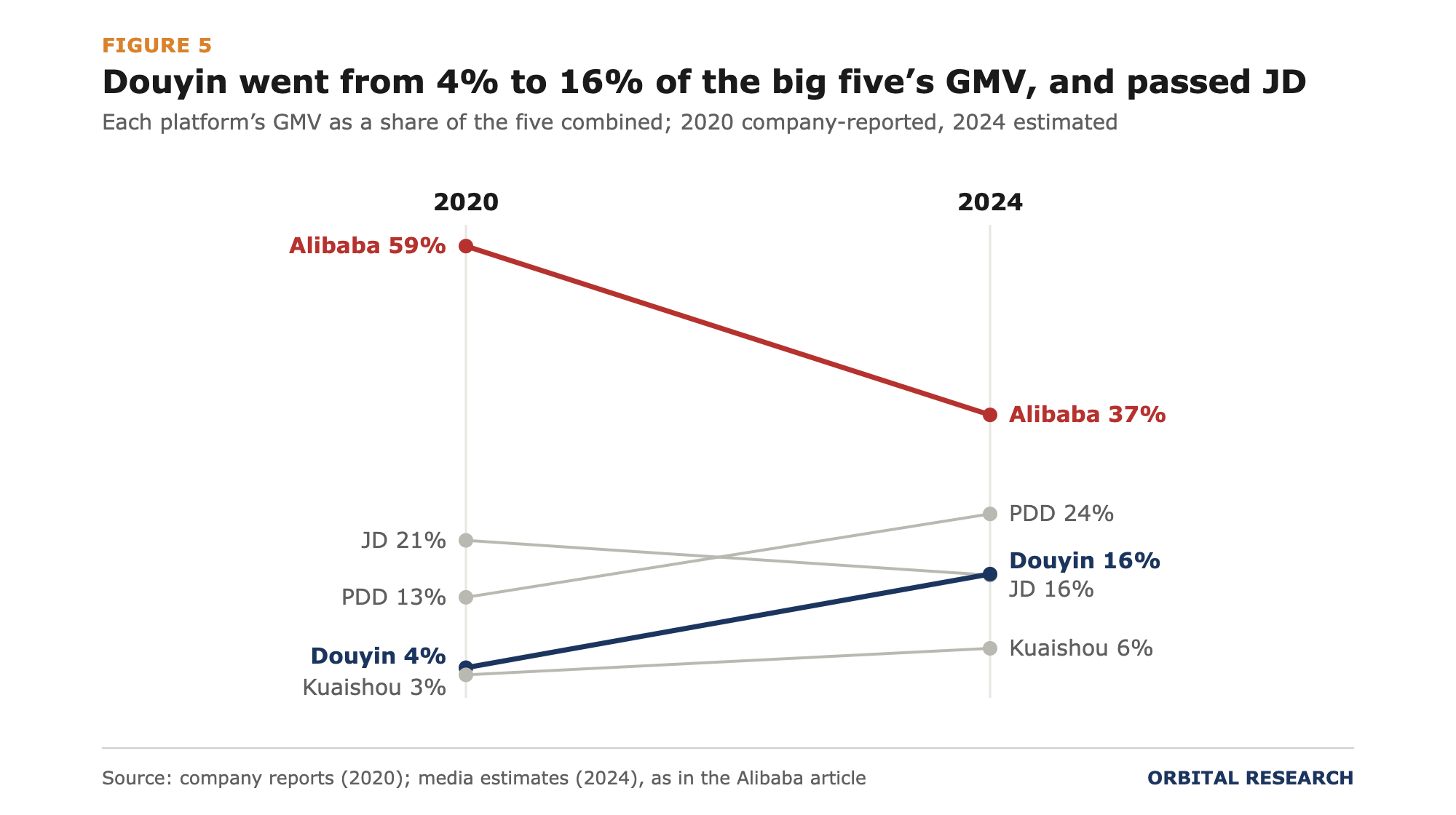
Douyin has not passed Alibaba in shopping. It has taken the share Alibaba lost and pushed JD to fourth.
Alibaba, step two: cloud and AI
The second step is happening now. ByteDance is ahead with consumers and developers, and behind on revenue and in the office.
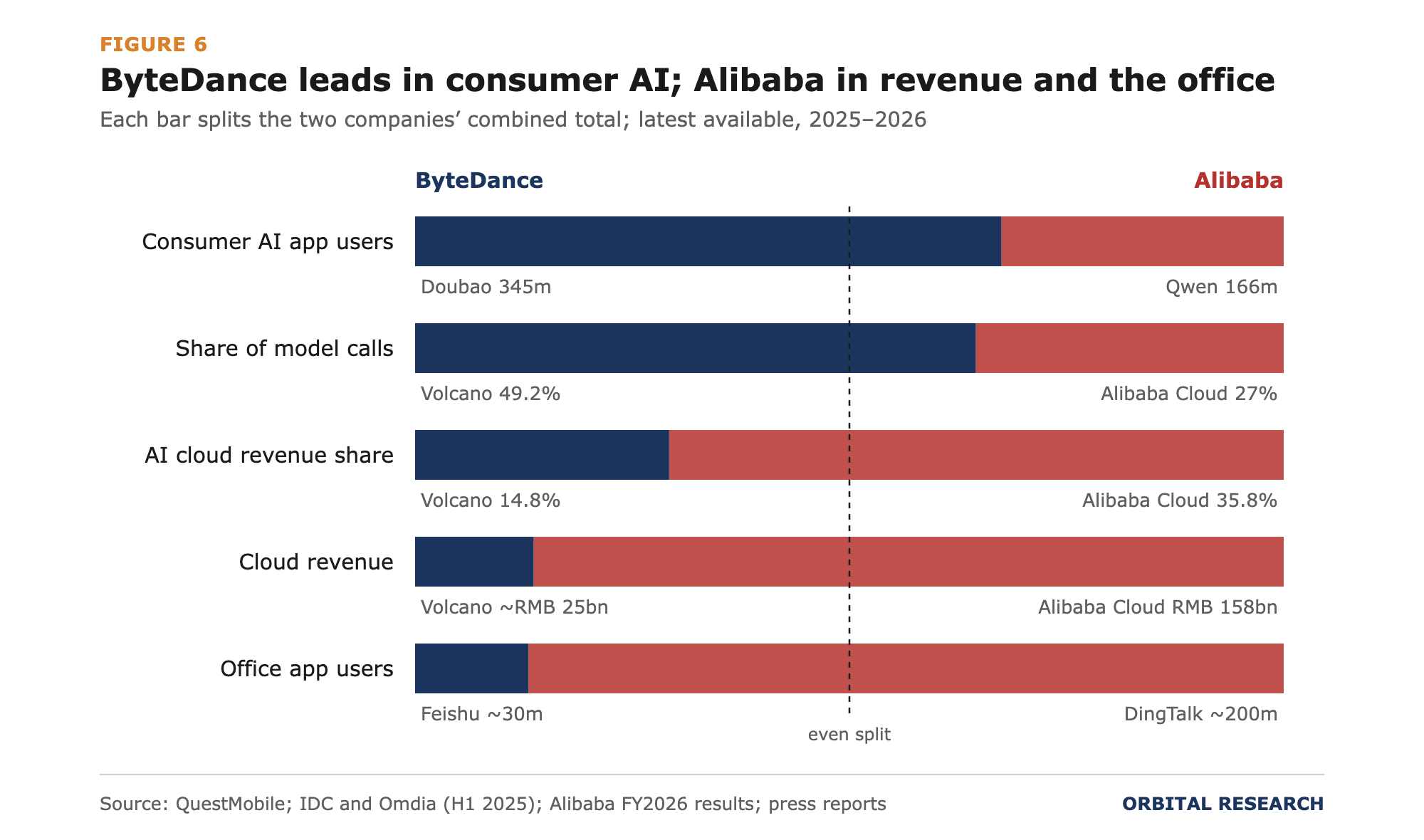
Sources: QuestMobile via Jiemian; IDC and Omdia via East Money; Alibaba results via Guancha; QuestMobile via 36Kr.
In e-commerce ByteDance arrived with users and turned them into revenue. In AI it has the users again. Whether it can turn them into revenue a second time is the question of the last section.
Tencent: the scoreboard
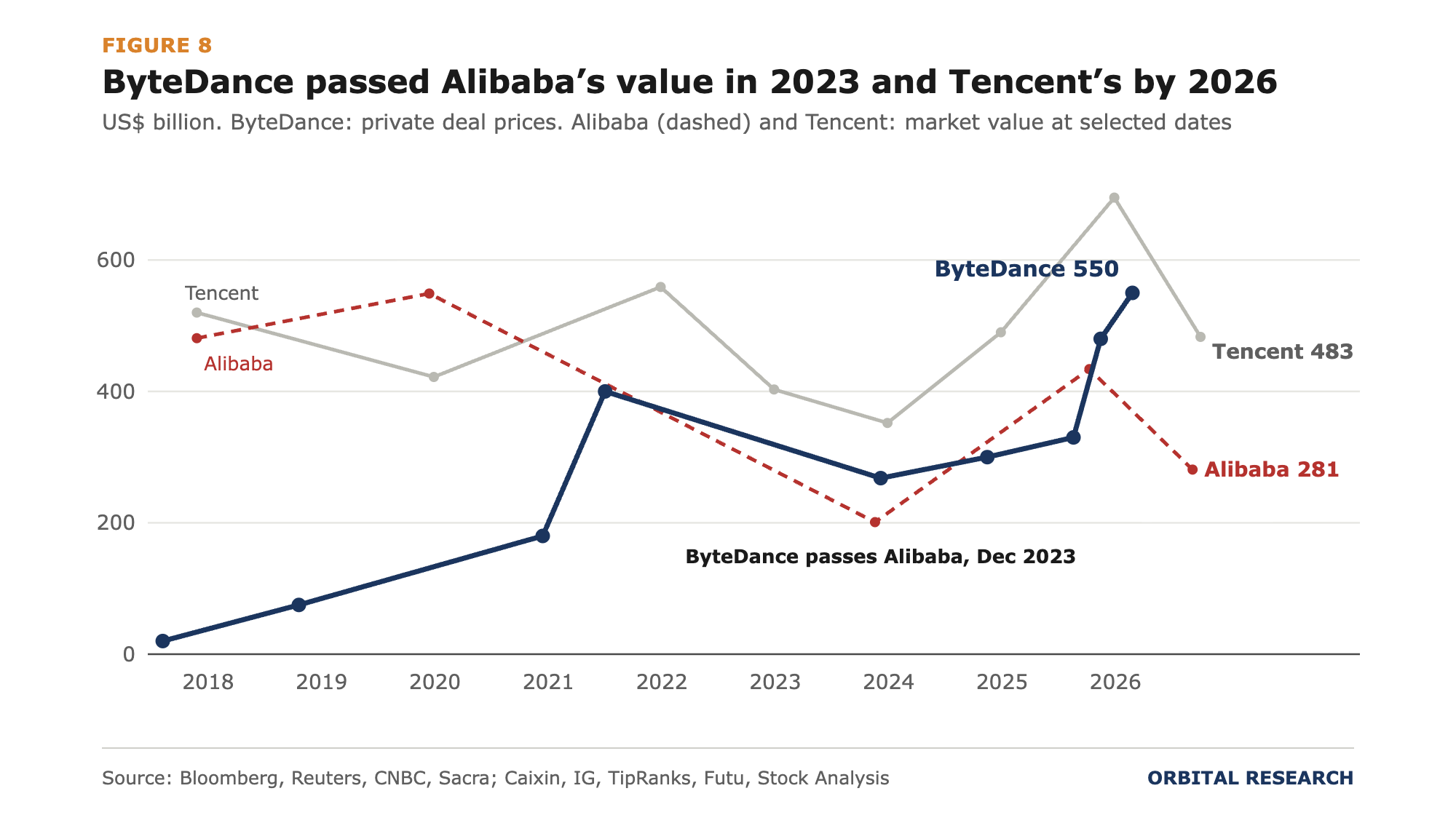
ByteDance passed Tencent on revenue first. In 2023 it took in about US$110–120 billion against Tencent's about US$86 billion. On valuation the order reversed: ByteDance's buyback price of US$268 billion in December 2023 was already above Alibaba's US$201 billion, but it took until 2026 to pass Tencent. In February a sale valued ByteDance at US$550 billion; by October Tencent was worth US$483 billion.
What the valuation suggests
One sign of what the white hole created is the rise in ByteDance’s reported valuation. General Atlantic first invested in 2017 at about US$20 billion and reportedly sold part of its stake in February 2026 at a US$550 billion valuation: a 27.5-fold increase in company valuation over about eight and a half years. Against the US$75 billion valuation of SoftBank’s October 2018 round, US$550 billion is about 7.3 times as much, or roughly 31% annualized valuation growth. These are company valuation multiples, not realized investor returns; they do not account for dilution, stake changes, transaction terms or cash distributions.
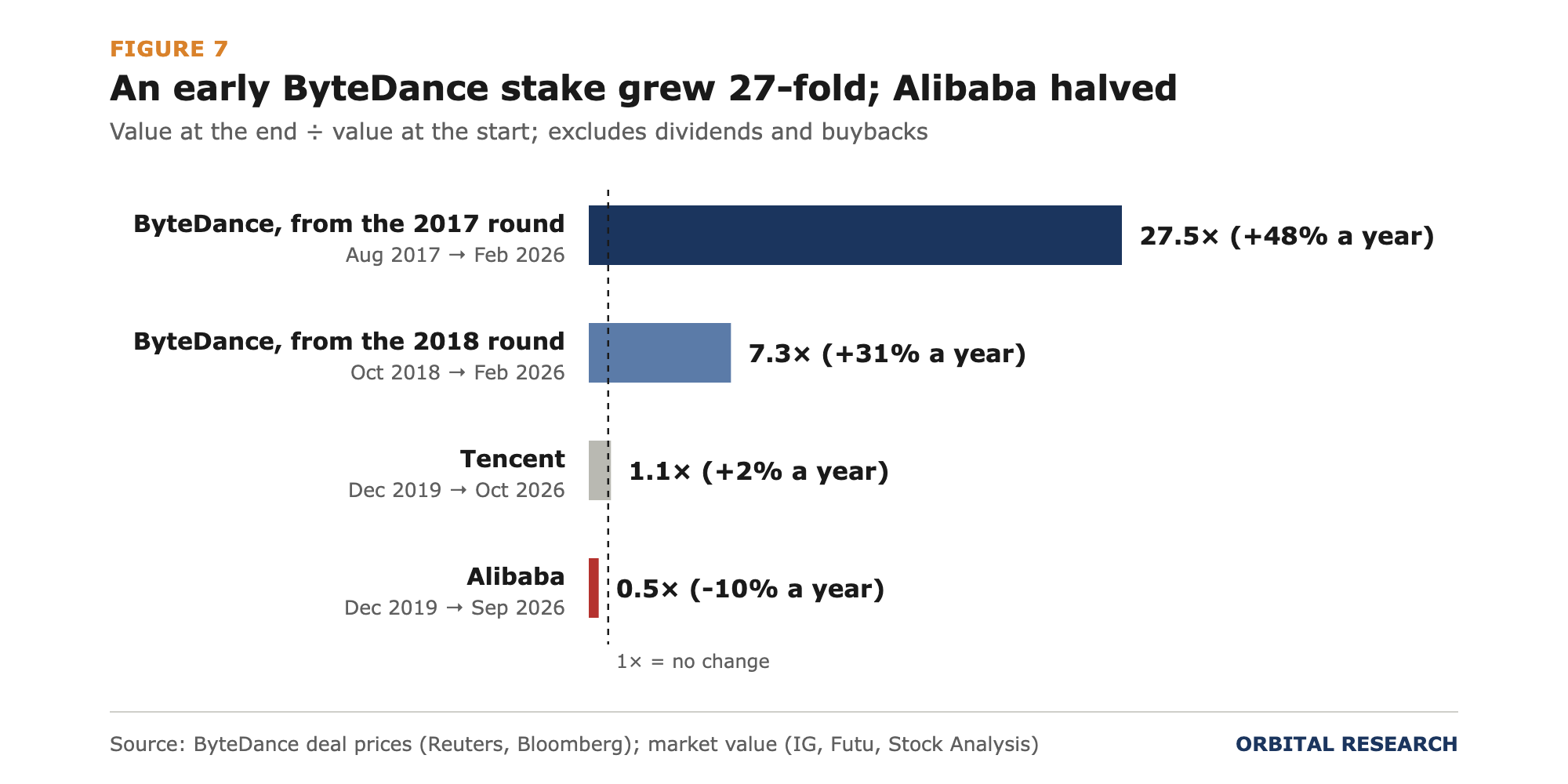
Chart note: These are company valuation or market-cap multiples over different periods, not realized shareholder returns. ByteDance’s private-company figures do not account for dilution or the terms of individual stakes.
Over a similar stretch, the two incumbents went sideways or down. At the end of 2019 Alibaba was worth US$549 billion and Tencent US$422 billion. By September and October 2026, Alibaba was worth about US$270 billion, half as much, and Tencent about US$483 billion, up roughly 15%.
The White Hole Expired
Douyin's white hole expired in 2021, the year it finally won the Spring Festival red packets. On New Year's Eve its main app hit 580 million daily users; after the holiday it fell back to 490–510 million. That November ByteDance told staff that its China ad revenue had stopped growing over the previous six months, the first time since it started selling ads in 2013. The same year its valuation peaked at about US$400 billion on secondary markets, then halved.
Zhang Yiming saw it first. In May 2021 he announced he would step down as CEO, and his memo to staff described the problem in his own terms:
Often when companies mature and expand, many fall into the trap of the CEO becoming overly central… This leads to an over-reliance on existing ideas already in the company, and results in knowledge structures being slow to iterate.
He said he had spent his time as CEO "listening to presentations, handling approvals, and making decisions reactively." That is what a company looks like when its white hole has stopped forcing anything new through.
The numbers after that read like a white hole that has stopped feeding. Revenue growth fell from 130% in 2019 to about 20% in 2025. In the first three quarters of 2024, quarterly China ad growth dropped from about 40% to under 17%.
The clearest sign was a resignation. On February 7, 2024, Zhang Nan stepped down as CEO of Douyin Group to work on AI creation tools at CapCut. ByteDance did not replace her. The post was abolished and Douyin's businesses were split among five managers. Alibaba's Zhang Yong left in 2023. At both companies the person who ran the narrow outlet left within months of each other. At ByteDance the job went with her.
She did not leave the company. She said 2024 was her tenth year there, and that she wanted to spend the next ten years on things she loved, "growing together with this AI era." The person who ran the first narrow outlet walked toward the next theme.
There is a counter-argument. Douyin's main app grew 14.7% in the year to September 2025 and passed one billion monthly users in March 2026. ByteDance's valuation reached US$550 billion in February 2026. But the growth came from apps Douyin incubated, such as Qishui Music, Hongguo short dramas and Douyin Mall, and from investors pricing in AI. Douyin was feeding new things. It was not itself opening a new outlet.
From Recommendation to Generation
For Alibaba, AI is a new theme. For ByteDance it is the next version of the old one: a machine deciding what you see, now writing it as well. But the economics run the other way. Recommendation also incurs serving and infrastructure costs, but advertising can scale with the attention it creates. Generation adds inference costs each time it answers. When a free user’s revenue does not cover those costs, more usage deepens the loss; that outcome depends on monetization and unit costs, not user growth alone.
I explore the broader economics in AI Had Its iPhone Moment. It Won’t Get the iPhone Economy: ongoing inference costs and competition over the customer relationship help explain why a widely used assistant need not become a durable platform business.
Doubao shows the problem. LatePost, as reported by IT Home in June 2026, said more than 200 million people used the app each day while daily revenue was under RMB 1 million, mainly from e-commerce commissions. The report estimated daily compute costs in the tens of millions of renminbi, excluding the model-training data-center costs; these are reported figures and estimates, not audited accounts. ByteDance reportedly cut promotion spending amid inference-cost pressure. It announced proposed subscription tiers at RMB 68, 200 and 500 a month, but June 1 coverage described a planned late-June launch and said details were still being tested. A subsequent reported decline of about six million monthly users after the announcement does not establish that pricing caused it. Free use funded by ads has not yet demonstrated that it can cover Doubao’s reported inference bill.
Still a black hole
ByteDance's AI strategy today is one theme with many bets, which is what a black hole looks like.
Table 3: ByteDance's AI bets, mid-2026
| Bet | Customer | What we can see |
|---|---|---|
| Doubao app | Consumers | 345 m monthly users in March 2026; overall app losses reported, not losses measured for every user |
| Doubao subscriptions | Consumers | Proposed tiers announced; late-June 2026 launch was reported as a plan |
| Volcano Engine model APIs | Companies | 49.5% of external-customer public-cloud MaaS Token usage in 2025; about RMB 1.5 bn revenue in 2025 |
| Seedance video model | Companies | Reported US$2 bn annualized revenue run rate in June 2026, not full-year realized revenue |
| TRAE coding tool | Developers | 12.8 m visits in June 2026 |
| Doubao enterprise + Feishu | Companies | In closed testing |
The company's own words fit the stage. At the 2024 all-hands meeting, Liang Rubo admitted that ByteDance had been less alert to the new technology than startups. Two years later, he told Volcano Engine's annual conference:
Climbing the peak of AI is the most important thing for ByteDance right now.
That is a theme, declared clearly. It is not yet an outlet.
The cloud comparison shows a different kind of lead. For the first half of 2025, IDC estimated Volcano Engine at 49.2% and Alibaba Cloud at 27% of public-cloud MaaS Token usage supplied to external customers, excluding the providers’ own apps. In Omdia’s broader AI cloud revenue market for the same half-year, Alibaba had 35.8% and Volcano Engine 14.8%. The Token-share figure later reached 49.5% for Volcano Engine over full-year 2025. These measure different markets and cannot be divided to infer revenue per call. ByteDance led external MaaS usage; Alibaba led the broader AI cloud revenue market.
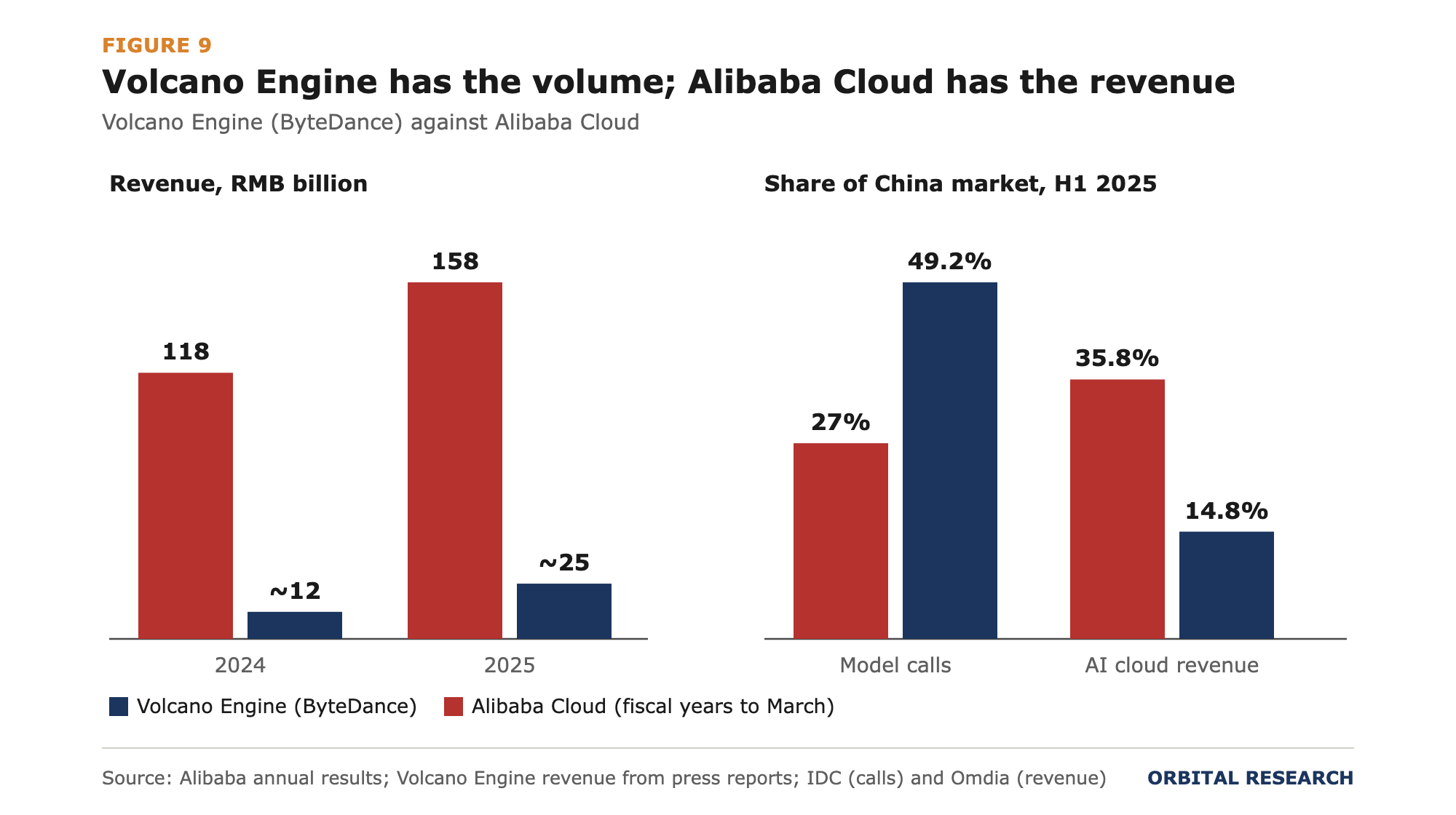
Chart note: External-customer MaaS Token usage and broader AI cloud revenue cover different markets. Their shares cannot be divided to estimate revenue per call. The half-year comparison uses H1 2025; the 49.5% Token figure elsewhere refers to full-year 2025.
Feishu as the harness
On July 30, 2026, ByteDance merged Feishu's product team into Doubao. Feishu's CEO now reports to Doubao's head; Feishu's sales team went to Volcano Engine. Nine days earlier, Alibaba had merged three agent products into Qianwen Office, run by DingTalk's new CEO. Every Chinese giant is putting its model inside office software. The difference is who is in charge. At ByteDance, the model team runs the office software. At Alibaba, the office team runs the model's office product. Tencent took a third path, below.
A model on its own is not a product. A model with a harness is: the documents, chats, calendars and permissions that let it do a job. Feishu is Doubao's harness. But this is a direction, not an outlet. There is no fixed deadline, no public result, and Doubao's enterprise edition is still in testing. By our own test, ByteDance has not found its second narrow outlet yet.
Table 4: The office battlefield
| App | Monthly users | 2025 revenue |
|---|---|---|
| DingTalk (Alibaba) | about 200 m | over RMB 4 bn |
| WeCom (Tencent) | about 100 m | — |
| Feishu (ByteDance) | about 30 m | over RMB 3 bn |
Source: QuestMobile, via 36Kr.
Tencent's answer: WorkBuddy
The office race has a third answer, and right now it is winning. Tencent launched WorkBuddy, a desktop agent that reads local files, runs tasks and hands back finished work, in early March 2026. By June it had 20.97 million monthly visits, more than the next two products combined, in a market that tripled from about 20 million visits in March to over 60 million. Tencent says it is already China's most popular productivity AI agent by daily users.
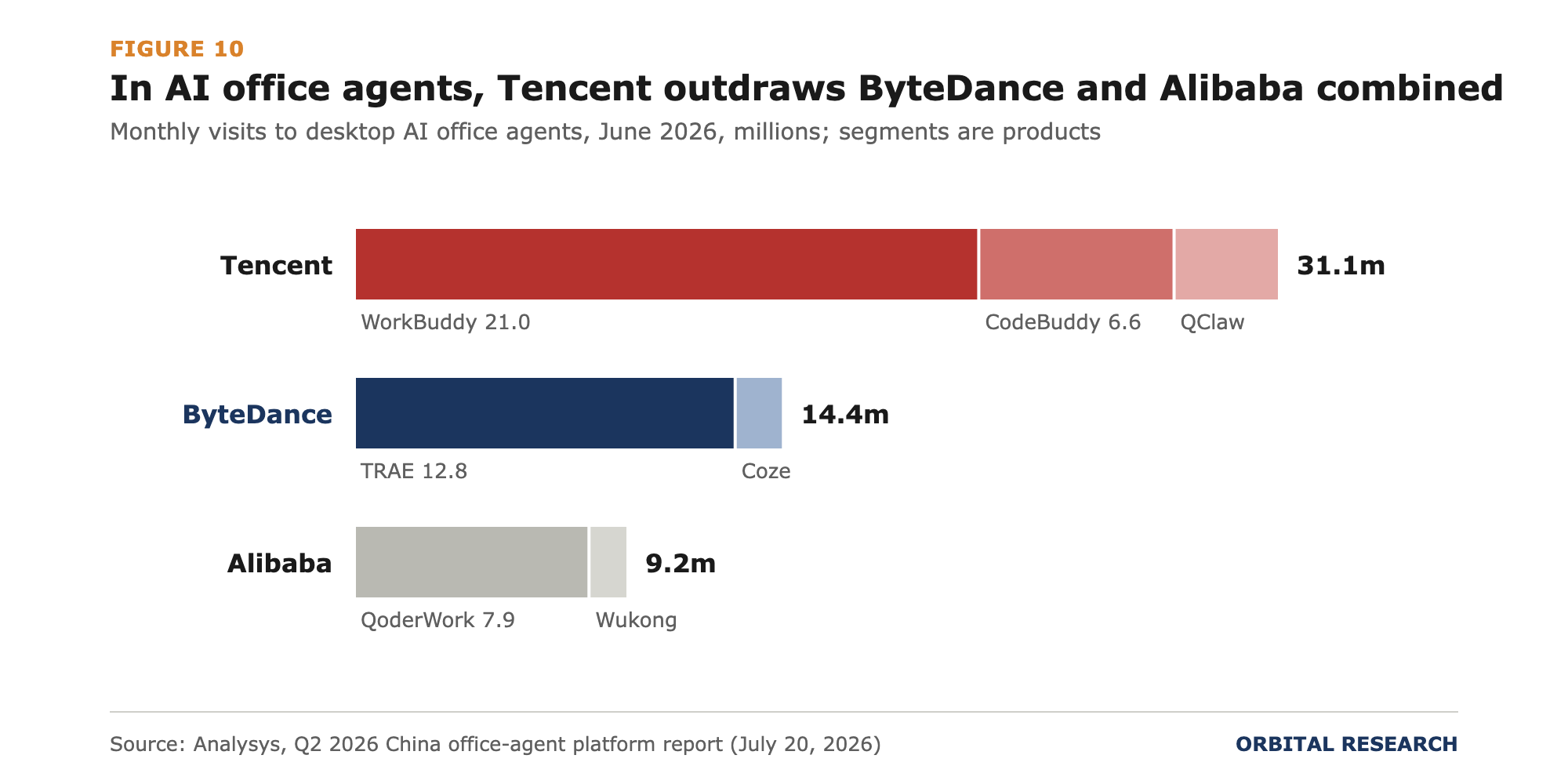
WorkBuddy is not tied to Tencent's own model. It runs on Hunyuan, DeepSeek, Zhipu GLM and Kimi, and takes tasks from WeChat and WeCom. Of the three giants, Tencent has the weakest model and the strongest front door, and it leads. That supports the point of this section, that the harness matters more than the model. It also cuts against ByteDance: Feishu is not yet the strongest harness. The cost is real too. Tencent's new AI products, WorkBuddy among them, cut its second-quarter operating profit by about RMB 10.5 billion.
The record that was not ByteDance's
The generation era has produced another rapid adoption milestone. Sensor Tower estimates that the ChatGPT mobile app reached one billion monthly active users in May 2026, calling it the fastest mobile app to do so. This is an analytics estimate for the mobile app, rather than OpenAI’s reported total audience, and it should not be treated as directly comparable to TikTok’s company-announced cross-market user figures. ByteDance’s first white hole formed at home and spilled abroad. This time it faces an established global rival; finding a domestic outlet would not by itself secure the foreign market.
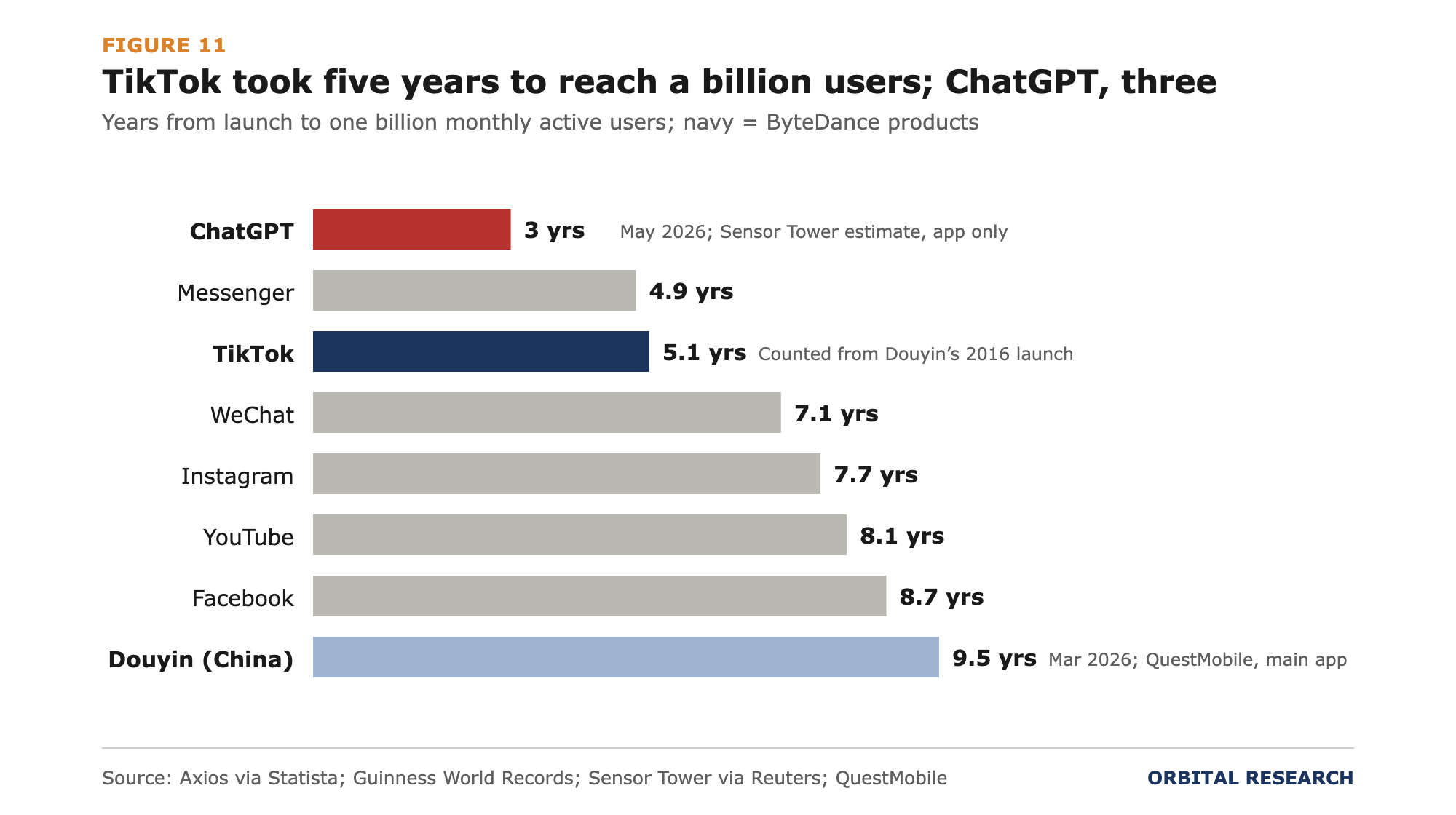
Chart note: These milestones are not directly comparable. TikTok’s reported audience and Sensor Tower’s estimated ChatGPT mobile-app users differ in scope, and Douyin’s launch is not TikTok’s launch date.
The Alibaba article ended with Alibaba stuck at the second question: a theme, but no narrow outlet. ByteDance is stuck at the same question, with more bets, more users and more money burning. The two companies are about to meet in the same place, the office.
In 2012, Zhang Yiming did not know recommendation, but he could learn it, and the economics rewarded him for every user he added. Generation can be learned too. ByteDance has the models, the compute and the users to learn it faster than almost anyone. What it does not yet have is the narrow door that turned the last theme into Douyin. Learning was enough the first time. This time the door has to be found.
A Note on the Numbers
ByteDance is private and publishes no audited accounts. Its revenue, profit and ad figures here come from media reports of internal numbers, mostly Bloomberg, Reuters and LatePost; user numbers are third-party estimates, mostly from QuestMobile. Where sources disagree, this article uses Bloomberg for revenue and QuestMobile for users. ByteDance's valuations are private-transaction prices and are not comparable one-for-one with listed companies' market values. As in the Alibaba article, the narrow outlet and the marker were chosen with hindsight. Quotes from Chinese sources are translated by the author; Zhang Yiming's 2021 memo is quoted from ByteDance's English release.
Get the next note
in your inbox.
Free research notes, selected readings and publication updates. No spam, unsubscribe any time.